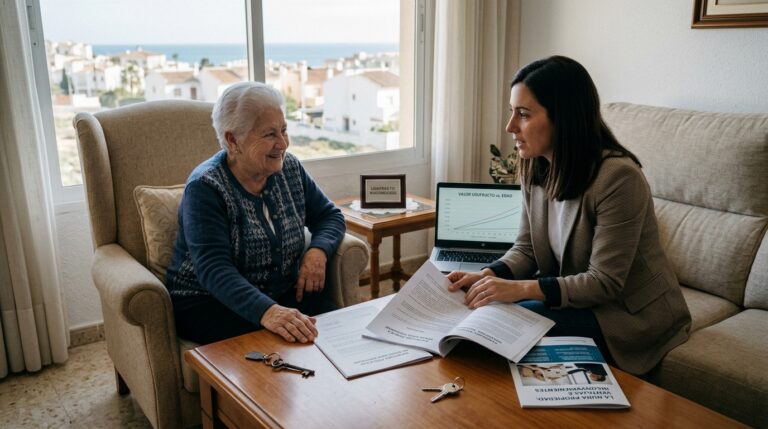
Thinking about buying a home on the Costa de Almería? This guide walks you through the whole process as it works in 2026 — from getting your NIE to signing at the notary — with real figures for taxes and costs in Andalucía, what changed after Brexit, and the mistakes we see international buyers make most often. ZAR 2010 has been helping buyers in Garrucha, Vera, Mojácar and San Juan de los Terreros for more than 30 years, and buyers pay us 0% commission.
Why the Levante Almeriense?
The stretch of coast between San Juan de los Terreros and Mojácar offers something increasingly rare in Spain: genuine seaside towns with year-round life, prices well below the Costa del Sol and Costa Blanca, over 3,000 hours of sunshine a year, and a property market with room to grow as the region gains connectivity. You can still buy a two-bedroom apartment near the beach in Garrucha or Vera Playa for a fraction of what an equivalent home costs in Marbella or Jávea.
Do you own a home in the area?
It is probably the best moment in almost 20 years to sell. We tell you what it is worth today, free.
Value my home →Step 1 — Get your NIE and open a Spanish bank account
The NIE (Número de Identidad de Extranjero) is your Spanish tax identification number and you cannot buy property without it. You can apply at a Spanish consulate in your home country or in Spain at the national police station (in our area, Almería city), directly or through a power of attorney given to your lawyer. Allow two to four weeks.
A Spanish bank account is not legally required but makes everything easier: paying utilities, community fees, taxes and the purchase itself. Most banks in the area have English-speaking staff.
Step 2 — Reserve the property and sign the private contract
Once your offer is accepted, the usual sequence is:
- Reservation contract — typically €3,000–€6,000 takes the property off the market while your lawyer runs checks.
- Contrato de arras (deposit contract) — normally 10% of the price. If the buyer withdraws, the deposit is lost; if the seller withdraws, they must return double. This is the legally binding heart of a Spanish purchase.
- Due diligence — your lawyer verifies the title at the Land Registry, checks for debts and charges (in Spain, debts follow the property, not the owner), confirms the home matches its registered description, and reviews community statutes and fees.
Step 3 — Completion at the notary
The sale completes when both parties sign the escritura pública (public deed) before a Spanish notary and the balance is paid, usually by banker’s draft or transfer through the notary. You receive the keys at the same moment. The deed is then registered in your name at the Land Registry. If you cannot attend in person, your lawyer can sign on your behalf with a power of attorney.
What does buying really cost? (Andalucía, 2026)
Budget roughly 10–12% on top of the purchase price for a resale home, or 12–14% for a new build:
- Resale: ITP (transfer tax) — flat 7% in Andalucía, one of the lowest rates in Spain.
- New build: 10% IVA (VAT) + 1.2% stamp duty (AJD) — you pay one or the other, never both ITP and IVA.
- Notary and Land Registry — typically €1,000–€2,000 combined, scaled to price.
- Independent lawyer — usually around 1% of the price. Strongly recommended, and they should be independent of the seller and the developer.
- Mortgage costs, if financing: valuation (€300–€600); since 2019 the bank pays the mortgage taxes and most set-up costs.
With ZAR 2010 there is nothing to add for the agency: the buyer pays no commission — our fee comes from the seller’s side.
Buying after Brexit: what UK buyers need to know
- You can still buy freely. Property ownership in Spain has never depended on residency or nationality.
- The 90/180 rule: as a non-resident you can spend up to 90 days in any 180-day period in the Schengen area. Many of our British clients simply plan two long stays a year around this.
- The Golden Visa ended on 3 April 2025 — buying no longer grants residency. The main routes now are the Non-Lucrative Visa (passive income, the usual choice for retirees) and the Digital Nomad Visa (remote workers).
- Non-resident tax (IRNR): owners pay a small annual tax on the property’s imputed income, plus local IBI (council tax). For a typical apartment this is a few hundred euros a year — your fiscal representative files it.
Mortgages for non-residents
Spanish banks routinely lend to non-residents: expect up to 60–70% of the valuation (residents get up to 80%), terms of 20–25 years, and proof of income from your home country. Get a pre-approval before house-hunting so you know your budget — we can introduce you to banks and brokers used to working with international buyers.
Planning to rent it out?
Holiday rentals work well in this area — Vera Playa, Garrucha and Mojácar have strong summer demand and a lengthening season. To rent legally in Andalucía you must register the home as a VUT (vivienda de uso turístico) with the Junta de Andalucía before advertising, and display the licence number on every listing. National-level registration rules introduced in 2025 have been partly overturned by the courts in 2026, so check the current requirements with your lawyer or with us when you buy — and note that some communities of owners can restrict holiday lets, so always review the community statutes first.
Five mistakes to avoid
- Skipping the independent lawyer to save 1% — the only professional working exclusively for you.
- Signing an arras contract before due diligence is finished.
- Not checking community fees, statutes and any planned extraordinary charges (derramas).
- Underestimating completion costs — keep that 10–14% buffer separate from your budget.
- Transferring funds without comparing exchange rates — a currency specialist can save thousands versus a high-street bank on a large transfer.
How ZAR 2010 helps
We are an independent, family-run agency on Calle Mayor in Garrucha, working this coast since 1993. We speak English, we know every development from San Juan de los Terreros to Mojácar phase by phase, and we accompany you from the first viewing to the notary — with 0% commission for buyers.
Start here: browse all properties for sale, see our new build developments, or contact us and tell us what you are looking for.
Frequently asked questions
Can I buy property in Spain as a non-EU citizen?
Yes, with no restrictions. You need an NIE number and the funds — nationality and residency are irrelevant to ownership.
How long does a purchase take?
Six to ten weeks from accepted offer to notary is typical for a resale with no mortgage; add three or four weeks if you are financing.
Do I become a tax resident by buying?
No. Tax residency depends on where you spend more than 183 days a year, not on owning property.
Is buying off-plan safe?
Yes, provided stage payments are covered by bank guarantees (aval bancario), which Spanish law requires — we only work with developers who provide them.