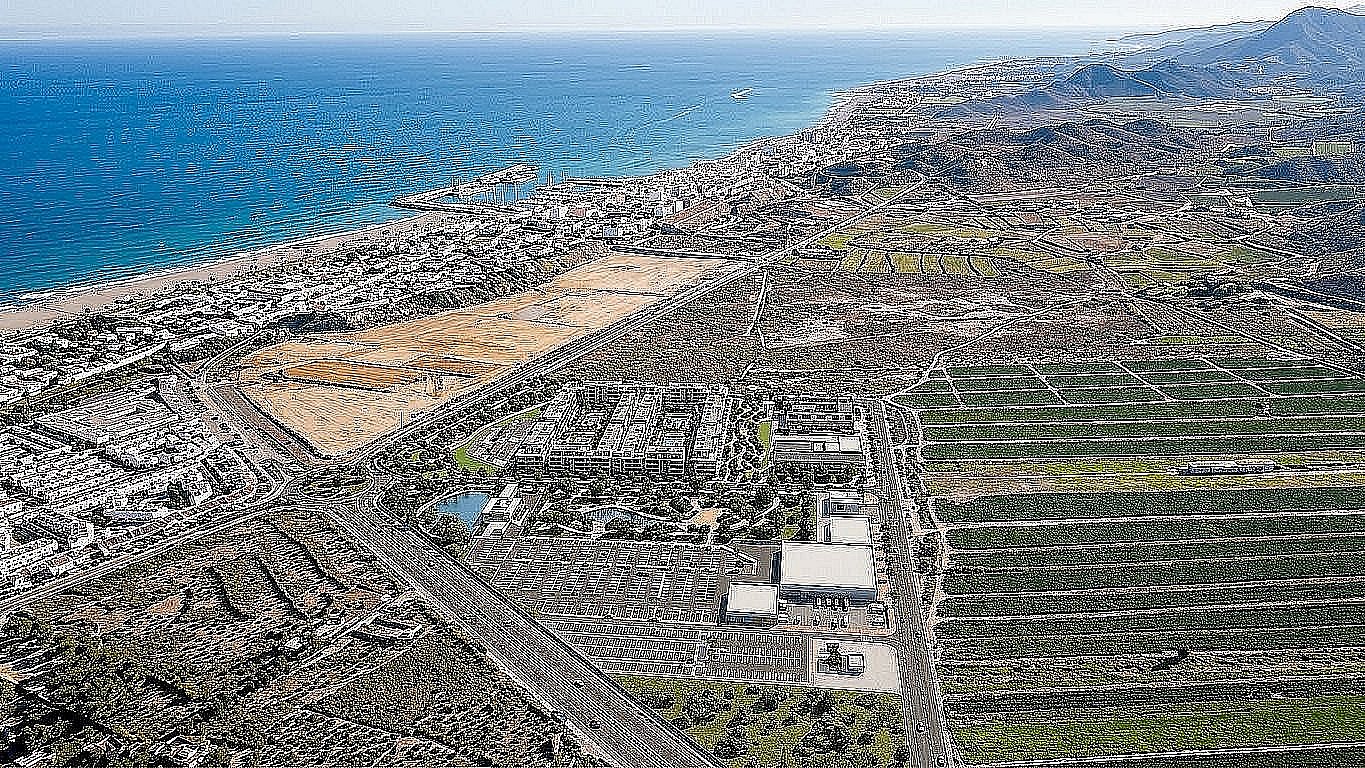
Garrucha is to get a large shopping centre at Las Buganvillas, La Voz de Almería reported a few days ago. It is still a plan rather than a building site. Even so, it has already raised the question that matters locally: what becomes of Calle Mayor, the town’s main shopping street? Our view is that the centre will not empty the street, but it will strip away its excuses. Calle Mayor has been changing trade for years, and a shopping centre, if one is built, merely hurries along a decision its owners should already be making.
We have spent thirty years selling and letting property in Garrucha, Vera, Mojácar and San Juan de los Terreros, and our office sits on that very street. We have watched local trade reshuffle each time new residents arrived, a road opened or a large development went up. A big retail scheme will follow the same pattern.
A district that does its big shop somewhere else
The area has grown steadily for fifteen or twenty years, driven largely by foreign residents who have made this coast their home or second home. On top of those on the padrón, the municipal register, there are people who spend half the year here without registering, and the summer crowds who swell demand every July and August. None of them has a large-format retail offer comparable to other parts of the province, so their money leaves: for the shopping centres of Almería city, for Murcia, for neighbouring districts. Ask any shopkeeper here and they will tell you as much.
That leakage is the scheme’s business case. In Spain, a gran superficie can mean anything from a hypermarket with a row of shops to a retail park of separate units with restaurants and leisure, and no plans have been published to say which this will be. The logical mix is whatever currently sends people out in the car: mid-priced fashion, electronics, homeware, food and leisure. The high-speed rail line to Vera, on its own timetable, will only strengthen the case that the area needs facilities matching its real population.
Calle Mayor changed long before anyone drew up Las Buganvillas
Online shopping took a large bite out of traditional retail well before this project was mentioned. Among the Calle Mayor premises that pass through our office, the same swap keeps happening. Where there was a clothes shop, a shoe shop or an electrical retailer, there is now a gestoría (an administrative agency), a clinic, a hairdresser, a tutoring academy or a professional practice.
Ten or fifteen years ago, many of those businesses would have worked out of a flat. Today they come down to street level because a shopfront gives them visibility at a rent that the retreat of conventional retail has made affordable. The street is not closing; it is changing tenants.
A shopping centre does not replace Calle Mayor. It forces the street to decide what it wants to become.
Small traders are right to worry, but about the wrong rival
The strongest counter-argument is a familiar one. A centre with free parking, big brands and long opening hours swallows the Saturday shopping trip, and the high street goes dark. For a shop selling exactly what a chain will sell, the risk is real and should not be played down.
Yet most of the spending Las Buganvillas captures will come from money that now ends up in Almería or Murcia, not from what stays on Calle Mayor. And the people now occupying those ground floors compete with no shopping centre: the physiotherapist, the tax adviser and the language school serve clients who live here all year and want proximity, a familiar face and a service that does not fit in a retail shed. Calle Mayor will remain the spine of Garrucha and finish specialising in local services, leaving volume and brands to those who sell them best. Specialising is not the same as declining.
The Malecón lives off the sea; Joaquín Escobar off its rents
The Malecón promenade plays a different game. Its business is eating and drinking by the sea, for residents and visitors who want precisely that, and no shopping centre can compete with a terrace overlooking the water. That role, settled for years, will only grow stronger.
Side streets such as Joaquín Escobar have a part of their own. They do not depend on passing footfall, which suits businesses that need no shop window but do need practical, reasonably priced space: an office, a small workshop, the stockroom of an online seller. For them, paying for a main-street frontage is money wasted.
Some shopfronts will end up as homes
Elsewhere in Spain, online shopping, expensive housing and retreating retail have combined to turn ground-floor shops into flats, where the layout and the town’s planning rules allow it. In Garrucha it is still rare, but it will come if the pressure on small retailers persists.
That need not be bad news for an owner. Premises that struggle as a shop may earn well as a home or an office, provided the planning position and the town hall’s requirements for a change of use are checked first.
Owners who decide early negotiate better
There is no opening date and no final design, and neither is needed to act. The owner of a Calle Mayor unit should already be asking which service business suits the space and what works it would need to take one in. Anyone looking for premises for a professional practice can now find main-street rents that were out of reach a decade ago. And anyone thinking of investing in the area should read the scheme for what it is: confirmation that enough people already live here to support it.
A shopping centre does not decide a street’s future. The owners of its ground floors do, and they choose better when they choose before the market chooses for them. If you would like to talk through your own premises with people who know every doorway in Garrucha, drop in to ZAR 2010 at Calle Mayor 48.
ZAR 2010, estate agents in Garrucha since 1995. Writing about the market and life on the Almería Levante.
How much is your home worth?
A realistic valuation of your property in the Almería Levante, with no obligation.